Monday, 10 September 2012


Thursday, 9 August 2012
Monstrous MOOCs..run in fear..from the HYPE???
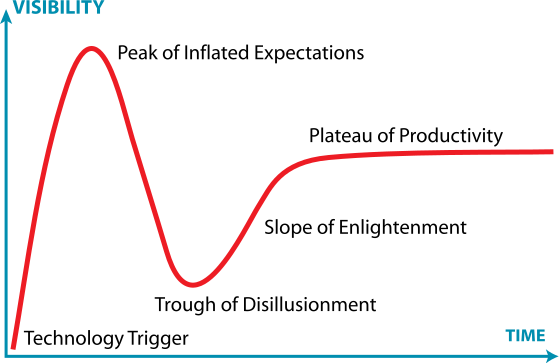
Well perhaps an over reaction, but there are some interesting comment pieces coming through - almost as a reaction to the hype. Have we reached the 'Peak of Inflated Expectations'?
Gartner's Hype Cycle of Technology Adoption
Guardian: 'MOOCs: a massive opportunity for higher education, or digital hype?' [08/08/12]
http://www.guardian.co.uk/higher-education-network/blog/2012/aug/08/mooc-coursera-higher-education-investment
"There are clear echoes here of the dot-com revolution of the late 1990s, reflected in the diversity of interpretations from higher education sector observers. Many share the view of the Stanford president that MOOCs replicate the disruptive innovations that have reshaped the global information, media and news industries, by shifting market power from the established players to parvenu start-ups and alternative providers".
[Hat tip: @drdjwalker on Twitter for the helping me identify the following]
2 from HYBRID PEDAGOGY: A Digital Journal of Teaching & Technology (http://www.hybridpedagogy.com)
Broadcast Education: a Response to Coursera
http://www.hybridpedagogy.com/Journal/files/Broadcast_Education.html
July 26, 2012
by Sean Michael Morris
"Coursera is silly. Educational technology news has been all a-flutter over the last few months about the work that Coursera is doing to bring higher education into the open. But I tell you what: I signed up for one of their classes -- a course on Science Fiction and Fantasy from the University of Michigan -- only to discover something really startling. Really: startling".
"Granted, I’ve only gotten a glance at what Coursera is doing; nonetheless, they appear to be offering the same brand of content that CCCO offered a decade ago -- but without the innovations and interactivity available when I left the school. The one extra thing they’ve added are video-taped lectures by well-known professors -- professors who, it turns out, don’t actually teach the course (I received an e-mail from a course “staff member”)".
The March of the MOOCs: Monstrous Open Online Courses
http://www.hybridpedagogy.com/Journal/files/MOOC_MOOC.html
July 23, 2012
by Jesse Stommel
"MOOCs are a red herring. The MOOC didn’t appear last week, out of a void, vacuum-packed. The MOOC has been around for years, biding its time. Still, the recent furor about MOOCs, which some have called “hysteria,” opens important questions about higher education, digital pedagogy, and online learning. The MOOCs themselves aren’t what’s really at stake. In spite of the confused murmurs in the media, MOOCs won’t actually chomp everything in their path. And they aren’t an easy solution to higher education’s financial crisis. In fact, a MOOC isn’t a thing at all, just a methodological approach, with no inherent value except insofar as it’s used".
All fascinating reading!! Are we about to enter the 'Trough of Disillusionment'??
[UPDATE]
Also found this article:
Inside Higher Ed: 'Slouching Towards Bethlehem: Unpacking the MOOC as Buzzword'
July 10, 2012
by Bonnie Stewart
Read more: http://www.insidehighered.com/blogs/university-venus/slouching-towards-bethlehem-unpacking-mooc-buzzword
"The problem, of course, with buzzwords is that they end up empty. In this case, each new media iteration of the term “MOOC” seems to tie it more closely to the behemoth of elite power + rapid change that drives the frenzy around disruption in higher ed".
"The problem with apocalyptic thinking is that it predisposes us towards simple solutions and salvation narratives, even in complex situations".
"MOOCs in their first inaugurations, led by George Siemens, Stephen Downes, and Dave Cormier, weren’t especially aimed at disrupting the university at all. They weren’t about the university, but about an alternate environment for learning. As Downes put it, 'MOOCs don't change the nature of the game; they're playing a different game entirely'".
Gartner's Hype Cycle of Technology Adoption
 |
| Source: http://en.wikipedia.org/wiki/File:Gartner_Hype_Cycle.svg |
Guardian: 'MOOCs: a massive opportunity for higher education, or digital hype?' [08/08/12]
http://www.guardian.co.uk/higher-education-network/blog/2012/aug/08/mooc-coursera-higher-education-investment
"There are clear echoes here of the dot-com revolution of the late 1990s, reflected in the diversity of interpretations from higher education sector observers. Many share the view of the Stanford president that MOOCs replicate the disruptive innovations that have reshaped the global information, media and news industries, by shifting market power from the established players to parvenu start-ups and alternative providers".
[Hat tip: @drdjwalker on Twitter for the helping me identify the following]
2 from HYBRID PEDAGOGY: A Digital Journal of Teaching & Technology (http://www.hybridpedagogy.com)
Broadcast Education: a Response to Coursera
http://www.hybridpedagogy.com/Journal/files/Broadcast_Education.html
July 26, 2012
by Sean Michael Morris
"Coursera is silly. Educational technology news has been all a-flutter over the last few months about the work that Coursera is doing to bring higher education into the open. But I tell you what: I signed up for one of their classes -- a course on Science Fiction and Fantasy from the University of Michigan -- only to discover something really startling. Really: startling".
"Granted, I’ve only gotten a glance at what Coursera is doing; nonetheless, they appear to be offering the same brand of content that CCCO offered a decade ago -- but without the innovations and interactivity available when I left the school. The one extra thing they’ve added are video-taped lectures by well-known professors -- professors who, it turns out, don’t actually teach the course (I received an e-mail from a course “staff member”)".
The March of the MOOCs: Monstrous Open Online Courses
http://www.hybridpedagogy.com/Journal/files/MOOC_MOOC.html
July 23, 2012
by Jesse Stommel
"MOOCs are a red herring. The MOOC didn’t appear last week, out of a void, vacuum-packed. The MOOC has been around for years, biding its time. Still, the recent furor about MOOCs, which some have called “hysteria,” opens important questions about higher education, digital pedagogy, and online learning. The MOOCs themselves aren’t what’s really at stake. In spite of the confused murmurs in the media, MOOCs won’t actually chomp everything in their path. And they aren’t an easy solution to higher education’s financial crisis. In fact, a MOOC isn’t a thing at all, just a methodological approach, with no inherent value except insofar as it’s used".
All fascinating reading!! Are we about to enter the 'Trough of Disillusionment'??
[UPDATE]
Also found this article:
Inside Higher Ed: 'Slouching Towards Bethlehem: Unpacking the MOOC as Buzzword'
July 10, 2012
by Bonnie Stewart
Read more: http://www.insidehighered.com/blogs/university-venus/slouching-towards-bethlehem-unpacking-mooc-buzzword
"The problem, of course, with buzzwords is that they end up empty. In this case, each new media iteration of the term “MOOC” seems to tie it more closely to the behemoth of elite power + rapid change that drives the frenzy around disruption in higher ed".
"The problem with apocalyptic thinking is that it predisposes us towards simple solutions and salvation narratives, even in complex situations".
"MOOCs in their first inaugurations, led by George Siemens, Stephen Downes, and Dave Cormier, weren’t especially aimed at disrupting the university at all. They weren’t about the university, but about an alternate environment for learning. As Downes put it, 'MOOCs don't change the nature of the game; they're playing a different game entirely'".
Wednesday, 8 August 2012
More on the MOOC...
Just came through from Twitter...all very intersting
ALT: Ng, Andrew and Koller, Daphne (2012) The Online Revolution: Education at Scale.
In: 2012 conference of the American Association for the Advancement of Artificial Intelligence. (Unpublished)
Article outline: http://repository.alt.ac.uk/2224/
43 page PDF: http://repository.alt.ac.uk/2224/1/From_Andrew_Ng_The_Online_Revolution_Education_at_Scale_20120806.pdf
"Big breakthroughs happen when what is suddenly possible meets what is desperately necessary".
Thomas Friedman, May 15, 2012 · New York Times
MOOC confusion?
I will have to admit I am a little bit late to this MOOC party, often ignoring some emerging technologies as I wait to see more evidence of them becoming more 'mainstream'. However since they are increasingly being implemented by a number of Universities, I guess they are become more mainstream, or is this good advertising for Universities???
In respect to pedagogy, I was interested to see how sophisticated they would be. Are they online self-directed courses with validation at the end? Can they be participatory? Are they designing the 'teacher' out of the relationship between learning and students, replacing it with a computer?
I will endeavour to find out more on these MOOCs and see what best practice they identify; that can be fed back into technology enhanced learning deliveries being mainstreamed at Universities.
It will be interesting to see how these MOOCs develop and whether it is disruptive for education. I am sceptical at the moment, but with all innovations, some fail and some succeed, and even if they do fail some good practices and tech often comes out from the exploration. At a minimum, it may change attitudes towards online education or raise an interest in investigating this field and driving maturity.
A starting point for me is this article:
ALT 'MOOC pedagogy: the challenges of developing for Coursera' [08/08/12]
http://newsletter.alt.ac.uk/2012/08/mooc-pedagogy-the-challenges-of-developing-for-coursera/
Will write more when I know more.
Tuesday, 7 August 2012
The Twitter Heptathlon...for online participation
In the spirit of the current very inspirational events going on in London, thought I would try and write a social networking challenge based on Twitter, a Twitter Heptathlon if you will!
Obviously this has an educational slant!
[1] Search or See Trends (finding current discussions and popular talking points)
[2] Follow (finding people that are relevant to your area of research or subject interest)
[3] List (compile a list of people you follow, in topic or subject groups)
[4] ReTweet or Favorite someone else's Tweet (identify comments, links or people you find interesting and promote them to your followers)
[5] Tweet, with or without a Hashtag (post an original comment on a topic or resource you have found / or join in with a current HashTag talking point)
[6] @Reply (Comment and respond to someone, posting a Tweet with your own view and/or resources)
[7] Start a new HashTag (Create a new theme or talking point)
The design of this activity is inspired by the excellent breakdown of 'The Four Cs of Participation in Online Communities' written about in Derek Wenmoth's blog [10/11/06]. This 4 Cs view, I can assume, follows a similar taxonomy view outlined by Bloom (see: Bloom's Taxonomy of Learning Domains)
Derek Wenmoth's Blog Post: Participation Online – the Four Cs [10/11/06]
http://blog.core-ed.org/derek/2006/11/participation_online_the_four_.html
Graphic or 4 Cs as steps (with detail): http://blog.core-ed.org/derekarchives/4Cs_large.jpg
In his blog post, Derek outlines the 4 Cs in the following way:
[1] Consumer
"The first phase is where participants (often referred to as lurkers) simply read and explore the posts of others. Far from being passive as the word lurker suggests, consumers can be very active participants in an online community – just not yet visible to others"
[2] Commentor
"as this label suggests, these people make comments on others posts (either on blogs, or in discussion forums), often seeking clarification, agreeing with a statement, or offering a suggestion or link to something similar"
[3] Contributor
"as this label suggests, contributors are those who have started their own blogs or who initiate new threads on discussion forums. They are confident about putting forth their own ideas etc"
[4] Commentator
"someone who frequently takes a ‘meta’ view of what is going on, providing a level of leadership within the community. Their contributions will often draw attention to the ‘bigger picture’, making links with other work – analysing and synthesising the contributions of others".
Let me know what you think?
Thursday, 2 August 2012
Bill Gates on Technology and Higher Education
Bill Gates has done a very interesting interview with The Chronicle of Higher Education. He points to an obvious yet too common misconception about technology or tools being able to change education, in that tools are just tools and it is what you do with them that is important. In addition, the affordances of technology can often be implicit as well as explicit...worth exploring this further re: Technology determinism [http://en.wikipedia.org/wiki/Technological_determinism].
Could write more - but am marking, so best get back to the job!!
The Chronicle of Higher Education, 2012
A Conversation With Bill Gates About the Future of Higher Education
http://chronicle.com/article/A-Conversation-With-Bill-Gates/132591/
Gates: "Just giving people devices has a really horrible track record. You really have to change the curriculum and the teacher. And it's never going to work on a device where you don't have a keyboard-type input. Students aren't there just to read things."
The Chronicle of Higher Education, 2012
Bill Gates on Higher Education, Part 2
http://chronicle.com/blogs/wiredcampus/bill-gates-on-higher-education-part-2/37423
Gates: "I know some critics worry about the loss of personal interaction that certainly is central to a high-quality education,” he said. “But this technology, when it’s well conceived, actually can be used to strengthen those interactions."
Wednesday, 25 July 2012
OU 'Innovating Pedagogy' 2012
http://www.open.ac.uk/personalpages/mike.sharples/Reports/Innovating_Pedagogy_report_July_2012.pdf
Areas covered:
New pedagogy for e-books
Innovative ways of teaching and learning with next-generation e-books
Publisher-led short courses
Publishers producing commercial short courses for leisure and professional development
Assessment for learning
Assessment that supports the learning process through diagnostic feedback
Badges to accredit learning
Open framework for gaining recognition of skills and achievements
MOOCs
Massive open online courses
Rebirth of academic publishing
New forms of open scholarly publishing
Seamless learning
Connecting learning across settings, technologies and activities
Learning analytics
Data-driven analysis of learning activities and environments
Personal inquiry learning
Learning through collaborative inquiry and active investigation
Rhizomatic learning
Knowledge constructed by self-aware communities adapting to environmental conditions
Vision+Skills+Incentives+Resources+Action Plan = Change
Vision+Skills+Incentives+Resources+Action Plan = Change
Donal O' Mahony has a useful blog post about the challenges of change management and the word grid is very useful when considernig technology implementation.
http://donalomahony.edublogs.org/2011/03/02/visionskillsincentivesresourcesaction-plan/
Give a quick scan - see what you think!
Educause: Analytics for Teaching, Learning, and Student Success
Great new interactive resource about the application of Learning Analytics.
http://www.educause.edu/events/educause-analytics-sprint
http://www.educause.edu/ero/article/building-performance-analytics-environment
Enjoy!
http://www.educause.edu/events/educause-analytics-sprint
- Building a performance analytics environment
- Tackling the full spectrum: Operational efficiency to learning otucomes
- Bolstering student success
- Implementing analytics on a shoestring
http://www.educause.edu/ero/article/building-performance-analytics-environment
Enjoy!
Back to Blogging...and more on Learning Analytics
Have had an eventful 3 months (wow too long since last post). Been teaching, going to conferences, meetings and more..
HEA Conference 3-4 July 2012, Manchester
http://www.heacademy.ac.uk/assets/documents/events/annualconference/2012/Annual_Conf_handbook_2.pdf
Very useful conference and saw lots of great sessions. I had a poster out in the innovations area with my line manager Sue Lee. The poster was about the work I have been doing on getting data out of Blackboard and using it to inform assessment design.
Poster title: 'Seeing the unseen: Using real-time data to measure online collaboration'
Basically the poster outlined the methodology of processing and the visualisation of data from Blackboard, exploring trends in behaviour and reflecting on assessment design for online collaborative group assessment. In addition, the data was also explored in respect to the field of Learning Analytics.
I will be delivering a session on this at the ALT-C conference 2012 'A confrontation with reality' 11-13 September, Manchester. If you are interested. http://www.alt.ac.uk/altc2012/
Sessions I attended (details from conference handbook).
UK higher education institutions and the OER university: ‘Snog, Marry, Avoid’?
04 July 10:45-11:15
Gabi Witthaus, University of Leicester
Alejandro Armellini, University of Leicester
This paper presents the findings of a HEFCEfunded SCORE fellowship that is investigating UK perspectives on the OERu (OER university) concept. Thirteen non-UK universities are collaborating to provide affordable higher education for learners in developing countries via OERs and low-cost assessment. Where do UK universities stand on this issue?
Student narratives from three London institutions: “they look at you as if ... ‘you don’t belong to us’”
04 July 12:00-12:30
Suzanne Kane, London Metropolitan Business School
Linda Johnson, London Metropolitan Business School
Debbie Holley, Anglia Ruskin University
Helen Pokorny University of Westminster
This research focuses on how students narrate their experiences of belonging, the meanings they ascribe to their narrations, and the insights these can offer our emerging understanding into the factors impacting on student expectations of university life and their sense of belonging. This research utilises the Biographic Narrative Interpretive Method (BNIM).
Developing digital universities
04 July 13:30-14:30
Helen Beetham, University of Exeter/JISC
David Baume, SEDA Sarah Knight, JISC
Universities must redefine their purposes for a digital world. Without focused planning and investment in digital capability, they can only react to the revolutions taking place in technology, knowledge and educational provision. This workshop will offer tools for assessing and progressing digital literacies as a strategic concern.
Useful resources / posters available from:
Baselining digital literacy provision
http://jiscdesignstudio.pbworks.com/w/page/46422098/Baselining%20digital%20literacy%20provision
https://files.pbworks.com/download/3TFqHtKppn/jiscdesignstudio/55148252/Outcome%20posters.pdf?ld=1
Monday, 23 April 2012
Quick Learning Analytics Publications Roundup
Learning Analytic: Enhancing Teaching and Learning Through Educational Data Mining and [draft for public comment]
U.S. Department of Education Office of Educational Technology
http://evidenceframework.org/wp-content/uploads/2012/04/EDM-LA-Brief-Draft_4_10_12c.pdf
The State of Learning Analytics in 2012: A Review and Future Challenges Technical Report
KMI-12-01 March 2012
http://kmi.open.ac.uk/publications/pdf/kmi-12-01.pdf
Keywords: academic analytics; action analytics; educational data mining; learning analytics; social learning analytics
ELI 2012 Online Spring Focus Session April 11–12 Learning Analytics
http://www.educause.edu/ELI124
SOLAR: Open Learning Analytics: an integrated & modularized platform
Proposal to design, implement and evaluate an open platform to integrate heterogeneous learning analytics techniques
http://solaresearch.org/OpenLearningAnalytics.pdf
Learning analytics:
http://evidenceframework.org/wp-content/uploads/2012/04/EDM-LA-Brief-Draft_4_10_12c.pdf
"As more of our commerce, entertainment, communication, and learning are occurring over the Web, the amount of data generated by online activities is skyrocketing. Commercial entities have led the way in developing techniques for harvesting insights from this mass of data for use in identifying likely consumers of their products, in refining their products to better fit consumer needs, and in tailoring their marketing and user experiences to the preferences of the individual. More recently, researchers and developers of online learning systems have begun to explore analogous techniques for gaining insights from learners’ activities online".
The State of Learning Analytics in 2012: A Review and Future Challenges Technical Report
KMI-12-01 March 2012
http://kmi.open.ac.uk/publications/pdf/kmi-12-01.pdf
Abstract: "Learning analytics is a significant area of technology-‐enhanced learning that has emerged during the last decade. This review of the field begins with an examination of the technological, educational and political factors that have driven the development of analytics in educational settings. It goes on to chart the emergence of learning analytics, including their origins in the 20th century, the development of data-‐driven analytics, the rise of learning-‐focused perspectives and the influence of national economic concerns. It next focuses on the relationships between learning analytics, educational data mining and academic analytics. Finally, it sets out the current state of learning analytics research, and identifies a series of future challenges".
Keywords: academic analytics; action analytics; educational data mining; learning analytics; social learning analytics
ELI 2012 Online Spring Focus Session April 11–12 Learning Analytics
http://www.educause.edu/ELI124
"Learning analytics (LA) is the collection and analysis of data associated with student learning. The analysis of this data, coming from a variety of sources like the LMS, the library, and the student information system, helps us observe and understand learning behaviors in order to enable appropriate interventions".
SOLAR: Open Learning Analytics: an integrated & modularized platform
Proposal to design, implement and evaluate an open platform to integrate heterogeneous learning analytics techniques
http://solaresearch.org/OpenLearningAnalytics.pdf
Learning analytics:
- Personal level: analytics on personal performance in relation to learning goals, learning resources, and study habits of other classmates.
- Course-level: social networks, conceptual development, discourse analysis, “intelligent curriculum”
- Departmental: predictive modeling, patterns of success/failure
Academic analytics:
- Institutional: learner profiles, performance of academics, knowledge flow, resource allocation
- Regional (state/provincial): comparisons between systems, Quality and standards
- National & International
Thursday, 29 March 2012
Gaming becomes 'Serious'
BBC: Unreal games engine licensed to FBI and other US agencies
"The Unreal computer games engine is being licensed to the FBI and other US government agencies. The software - which powers titles including Batman: Arkham City, Mass Effect 3 and Infinity Blade - will be used for training programmes. Developer Epic Games and its partner Virtual Heroes described the deal as a "long-term" agreement to support the technology on web browsers, consoles and handheld devices".
In respect to 'Serious Gaming' the entry from Wikipedia says:
"A serious game is a game designed for a primary purpose other than pure entertainment. The "serious" adjective is generally prepended to refer to products used by industries like defense, education, scientific exploration, health care, emergency management, city planning, engineering, religion, and politics".
This merging of the entertainment industry and the training industry is nothing new but there is something new and interesting about the maturity of the games industry being in a position to be the lead.
The recent release by UbiSoft of Anno 2070 was an interesting 'politcal' game which explored how the world reacts to a global climate change threat. See: Anno 2070
The emersive games environment has matured in recent years and many have experienced some impressive 'real-world' games and some 'fantasy worlds' that allow an open experience where your decisions and actions have conseqences in the game.
Three recent examples are Red Dead Redemption (Historic), Elder Scrolls V Skyrim (Fantasy) and Modern Warfare 3 (Pseudo-Contemporary). What is interesting about these games is the use of player choices to determine outcome, performance and levelling up options .
S
These examples are impressive - I wonder if and when educational games match these experiences?
Tuesday, 27 March 2012
Connectivism and eLearning
Some interesting comments from Grainne Conole on Twitter today about Connectivity, and in her blog post: http://e4innovation.com/?p=546
This reminded me of the line 'We don't teach; we set up conditions for learning' that appeared in:
INTERNATIONAL JOURNAL OF INSTRUCTIONAL TECHNOLOGY AND DISTANCE LEARNING March 2006 Volume 3 Number 3 http://www.itdl.org/journal/mar_06/Mar_06.pdf
The main issue being discuss by Conole was about designing for new open learning environments. This is reflected in George Siemens' comments - made in the above article:
"The problem rests largely in the view that learning is a managed process, not a fostered process. When learning is seen as managed, an LMS is the logical tool. When learning is seen as a function of an ecology, diverse options and opportunities are required".
Designing for the presentation end of the 'Blended Learning Continuum' (see N. Jones Glamorgan Uni) is more straight forward when management is the goal. However, as Siemens points out, when you need to create more open learning ecology the design process is a more taxing problem. My own opinion on this is to create a service-based VLE that offers functionality and 'affordance' that facilitates:
- The sharing of products
- The disclosure of learning activities and engagement (see Facebook)
- The communication between peers and learning facilitators
- The co-creation (remixing) and the adding of learning attributes to learning artifacts (this could include assessment)
Games, Gamers and eLearning
Grainne Conole posted a great link today on Twitter:
James Paul Gee on Learning with Video Games
Link to YouTube video
This is a great companion to Donald Clark's article 'Games and e-learning' [PDF]:
Here’s ten things that games have to offer learners?
James Paul Gee on Learning with Video Games
Link to YouTube video
This is a great companion to Donald Clark's article 'Games and e-learning' [PDF]:
- Learning from games
- What do existing games teach us?
- How can games accelerate learning?
- Affordable 3D simulations and games
- Conclusion
Here’s ten things that games have to offer learners?
- Motivation
- Learner-centricity
- Personalisation
- Incremental learning
- Contextualisation
- Rich media mix
- Safe failure
- Immediate feedback
- Lots of practice and reinforcement
- Lots of collaboration
Monday, 19 March 2012
BBC: Pupils ask search engines ahead of parents, survey says
News Article: http://www.bbc.co.uk/news/education-17302710
"Some 54% of the 500 children asked said Google and other search engines were their first port of call when seeking information, pushing parents into second place on 26%. Only 3% would ask their teacher. The survey for Birmingham Science City also suggests many pupils think their parents could not do their homework. Some 34% thought their homework was beyond their parents".
Tuesday, 13 March 2012
NUS Student Experience Research 2012
New publication is out: http://www.qaa.ac.uk/Publications/InformationAndGuidance/Documents/Student-Experience-Research-2012-Part-1.pdf
Key quotes on technology:
Key quotes on technology:
"Students also increasingly want to use technology to communicate with their institution, and we must ensure that there are robust technology infrastructures in place to accommodate students developing needs to have more interactions with university staff online." (p.2)
"Students want academic staff to develop their teaching styles to be more engaging, interactive and use technology and props to make the subject more accessible and interesting." (p.22)
"We’ve got an interactive clicker thing. They’ll put up a question and see how many people know the answer. That’s better in a way because you don’t have people who are worried about putting their hand up and feeling embarrassed. They’ll put this on in the lecture to check your understanding. It’s multiple choice and you get two minutes to work it out. If there are people who get it wrong then the lecturer will go through it with you, if a lot of people get it right then they’ll move on." (p.10)Some things to mull over here....
Back to blogging but big thanks to The Guardian!
Been a busy few months going to conferences, teaching on an online DL course, launching a technology supported learning pilot and contributing to a Guardian live web chat.
Here are the links to the Guardian work:
Technology in HE teaching: blended learning and beyond (10/02/12)
http://www.guardian.co.uk/higher-education-network/blog/2012/feb/06/blended-learning-in-higher-education
20 tips and resources for using learning technology in higher education (06/03/12)
http://www.guardian.co.uk/higher-education-network/blog/2012/mar/06/using-technology-in-university-teaching
Really enjoyed this and is a perfect example of social netorking as got invited through Twitter!!
Friday, 20 January 2012
Sheena Iyengar: How to make choosing easier
- Some important points here that can be applied to learning design - especially with respect to Distance Learning.
Subscribe to:
Posts (Atom)